
It’s everywhere. From haute couture runways to the shelves of mainstream retailers like Courir, the Nike Shox has once again found its way onto our feet. How has this silhouette from the 2000s, once relegated to the back of the closet, managed to make such a powerful comeback? What role have designers and collaborations played in its revival? A closer look at an iconic sneaker that still has plenty to offer.
An engineering marvel straight out of the 2000s
It took more than ten years of research and development for Shox technology to finally emerge at the turn of the millennium. Originally conceived as a high-performance running shoe, the Nike Shox made an immediate impression when it launched in 2000, thanks to its unconventional silhouette. Its defining feature was a sole equipped with polyurethane columns beneath the heel, acting as springs directly inspired by the suspension systems used in Formula 1 and the automotive industry.
The technical ambition was unprecedented at the time, as the goal was to propel athletes forward while absorbing as much impact as possible. The model’s ingenuity lay in its ability to provide optimal cushioning without compromising energy return or slowing down a runner’s stride. Beyond performance, the revolution was primarily visual: for the first time, the shoe’s internal mechanics were on full display rather than concealed within the sole.
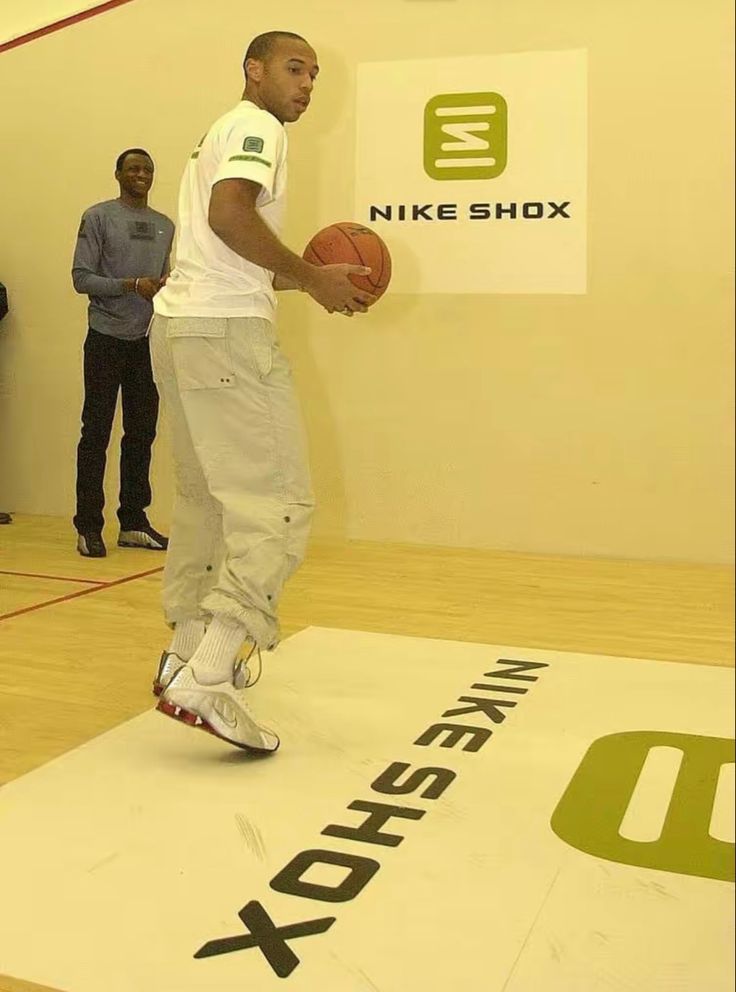
This bold design was the work of Bruce Kilgore, one of the most influential figures in sneaker design history, who had already created the legendary Air Force 1. Although its designer had initially envisioned it as a running shoe, it was on the basketball court that the Shox would truly cement its legendary status. At the 2000 Sydney Olympics, American basketball player Vince Carter performed a spectacular dunk over French center Fred Weis. Wearing the Nike Shox BB4, he gave the model worldwide exposure and recognition.
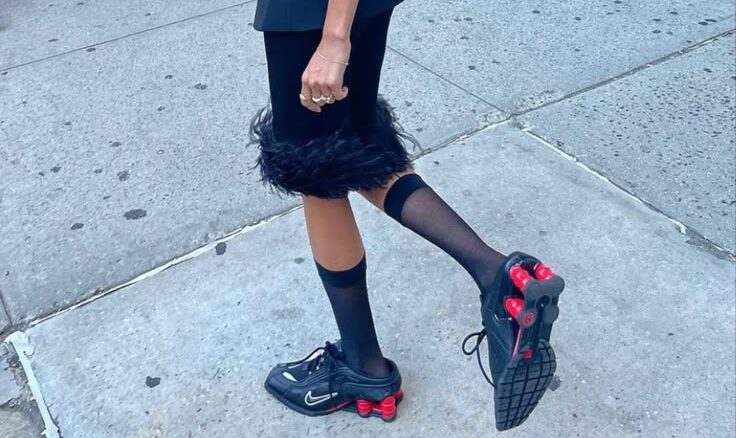
The very first model designed for the public, the Nike Shox R4, quickly transcended its sporting origins to become a symbol of streetwear. More than two decades later, the widespread revival of 2000s aesthetics brought the line back into the spotlight. The sneaker can now be spotted on some of contemporary fashion’s most prominent figures, including Bella Hadid, Irina Shayk and British singer PinkPantheress.
Gen Z’s unisex uniform
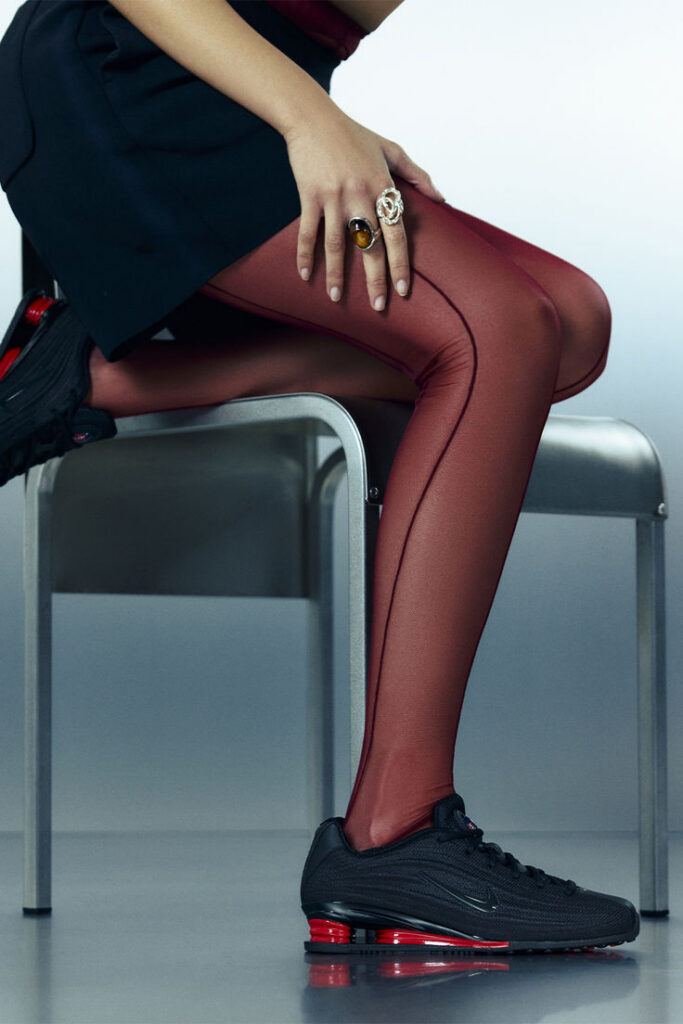
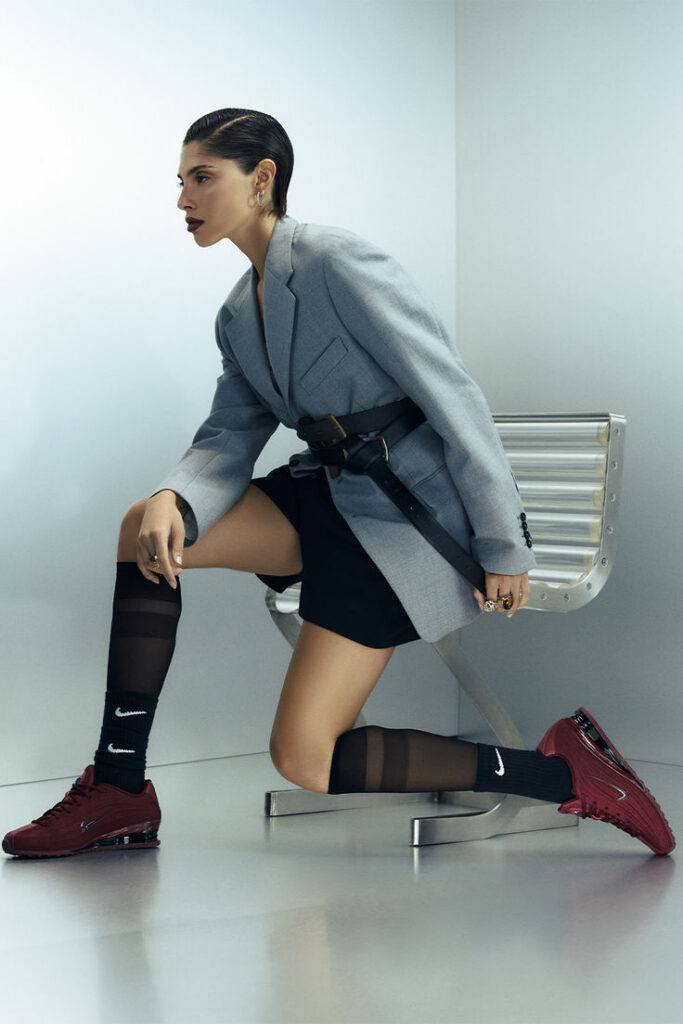
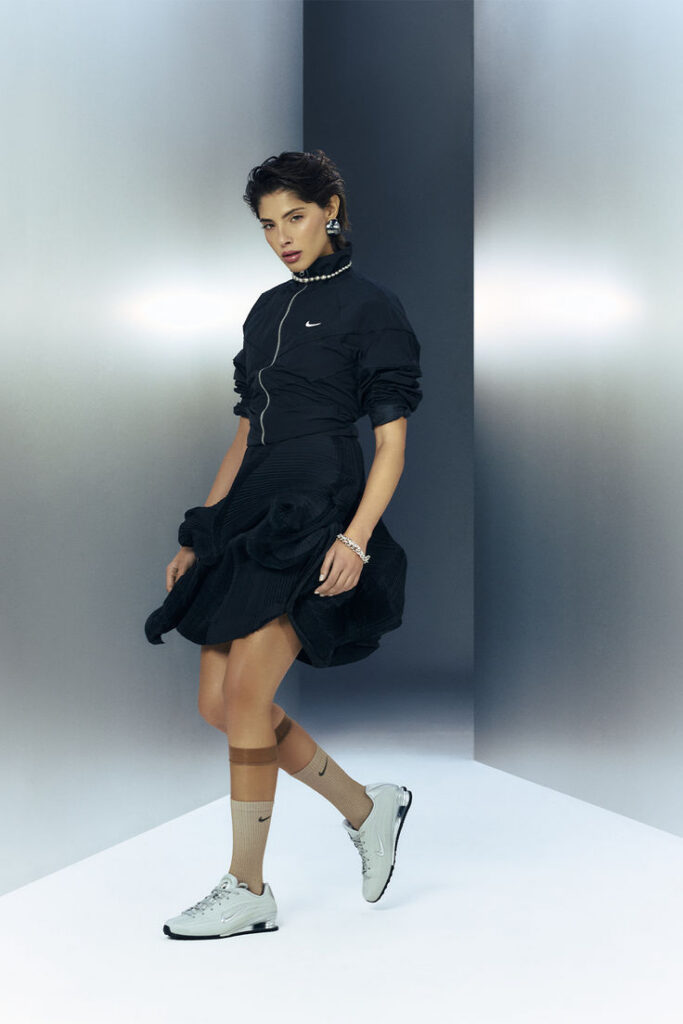
From fashion runways to school gates, the Shox has established itself as THE must-have sneaker in teenage wardrobes. Frequently paired with oversized sweatpants and a fleece hoodie, the Nike Shox has become Gen Z’s new unofficial uniform, occupying the central position once held by the Air Force 1 a decade ago.
Fully aware of this enthusiasm, the Swoosh brand has pursued a particularly aggressive expansion strategy, multiplying variations of the model. Nike has notably introduced slimmer, more feminine silhouettes in highly fashionable shades such as burgundy and chocolate brown, as seen with the Nike Shox Z. For fans of chunkier designs, the Shox TL takes the concept of the bulky sneaker to the extreme, featuring a sole made entirely of spring-like columns from toe to heel.
The Nike Shox R4, the original model in the range, is still produced by the brand and available from mainstream retailers such as Courir. If the sneaker can now be seen on virtually every street corner, it is also because Nike has invested heavily in the line in recent years, giving it pride of place in store windows. However, the real secret behind its renewed popularity lies not only in its widespread commercial availability, but also in its ability to serve as an endless source of inspiration for designers collaborating with the brand.
The Shox: A creative canvas and designers’ favourite


A true playground for designers, the Shox boasts such a distinctive structure that it sparks the imagination of labels around the world. Recently, London-based label Corteiz, founded by Clint, turned its attention to Shox technology with the creation of the Shox 419, following the enormous success of its reinterpretation of the Air Max 95. In a direct nod to the sneaker’s automotive origins, the designer drew inspiration from the lines of a Mercedes-Benz SLR McLaren, which also served as the backdrop for the launch campaign.
Long before Corteiz, a host of renowned designers and brands had already put their own spin on the silhouette. British designer Martine Rose played a major role in bringing the sneaker back into the spotlight, deconstructing it and transforming it into a chic, colourful square-toed mule. Japanese label Comme des Garçons added a touch of bling by embellishing it with an oversized jewellery chain, while other designers such as Calistra have recently reimagined it as a hybrid ballet flat. Meanwhile, British rapper Skepta customised the sneaker to reflect his own style, incorporating his signature red sole as a tribute to London’s underground culture.
Nike Shox’s triumph rests above all on its original technical innovation and futuristic design, which has not aged a day in twenty years. Its bold silhouette effortlessly bridges the gap between its streetwear heritage and the exclusive world of luxury ready-to-wear. Lending street credibility to those who wear it every day, it simultaneously retains its status as a cutting-edge fashion object that enthusiasts continue to covet. Ultimately, the Shox proves that an avant-garde design can transcend two decades and continue to appeal to every generation.